Territories of Presence
Fabio Knoll’s photographic work unfolds at the intersection between geography, human experience and visual contemplation. Trained as a geographer, his practice does not approach the world merely as scenery or subject matter, but as a network of lived territories in which human existence continuously takes form.
Rather than isolating events or dramatic moments, Knoll’s images observe the subtle structures through which life inhabits space: domestic interiors, ritual gatherings, urban margins, remote landscapes and the fragile architectures of everyday existence. Across different continents and cultures, his photographs reveal a persistent inquiry into how human beings inhabit the world and how territories, in turn, shape the rhythms of human presence.
At the core of his work lies a phenomenological attention to the act of seeing. Knoll’s photographs often unfold in spaces of transition: doors, corridors, roads, windows, thresholds where interior and exterior meet. These liminal spaces function not merely as compositional devices but as conceptual anchors. They situate the viewer within a moment of passage — between solitude and community, silence and gesture, nature and culture.
In this sense, his photographs resist the immediacy typical of much contemporary documentary practice. Instead of seeking spectacle, they cultivate duration. The viewer is invited to inhabit the image slowly, perceiving the relationships between bodies, objects, architecture and landscape. Space becomes an active participant in the image, not a neutral background.
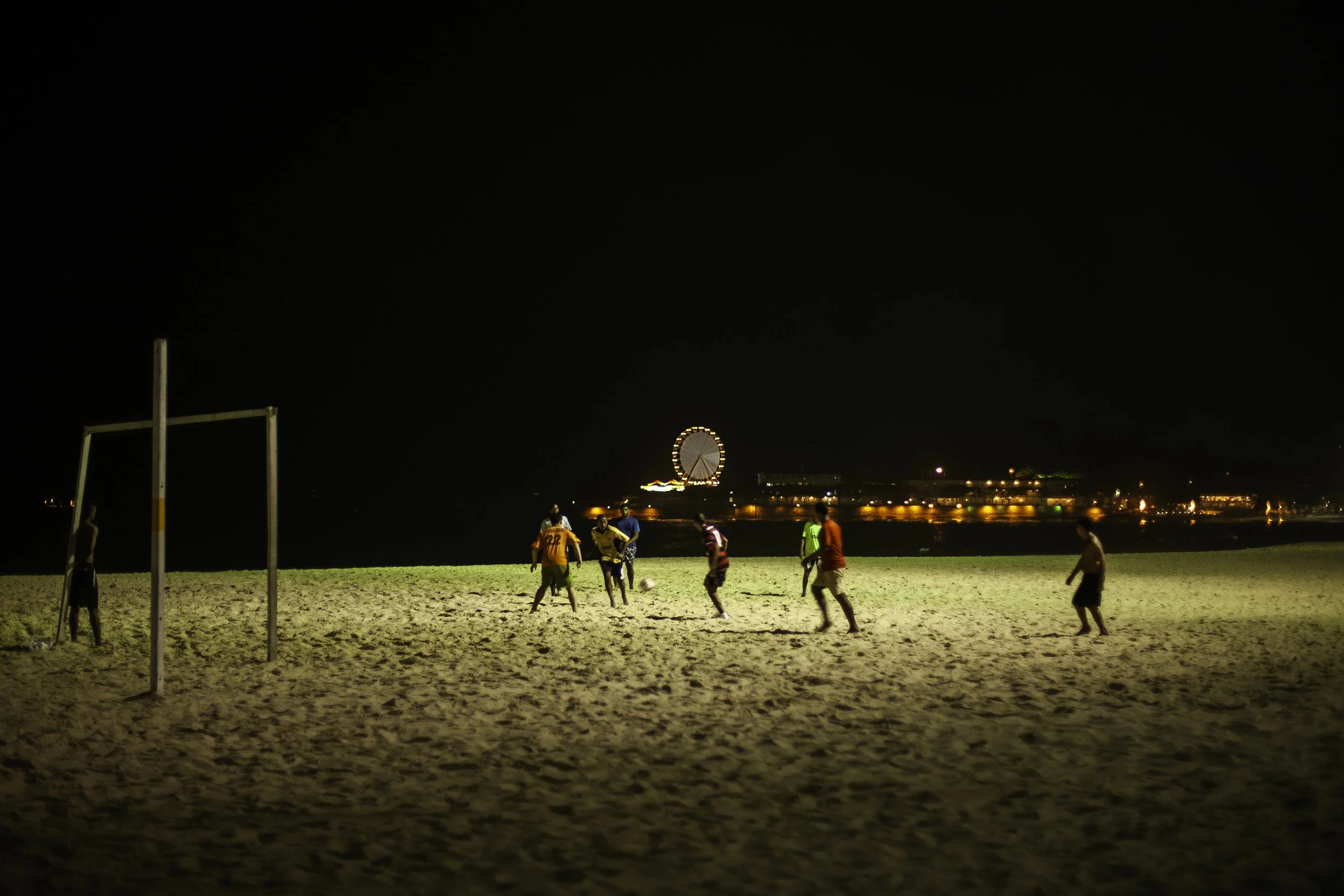
This spatial sensibility produces images structured through layers of depth. Foreground, human presence and distant horizon frequently coexist within the same frame, creating visual environments rather than isolated scenes. Such compositional strategies resonate with both cinematic language and the traditions of humanist photography, while maintaining a distinctive contemplative character.
Knoll’s visual universe is also marked by a coherent chromatic atmosphere. Earth tones, deep blues and organic greens recur throughout his work, grounding the images in the material textures of the environments he encounters. These colors do not impose aesthetic stylization; rather, they emerge from the territories themselves — from soil, architecture, vegetation and the atmospheric conditions of the places he traverses.
Across series produced in Brazil, Africa, Asia and other regions, the photographer consistently returns to a central question: how does life manifest within the territories it inhabits?
The answer unfolds not through explanation but through observation. A solitary figure inside a dimly lit room, children reading in silence, a ritual unfolding around a fire, the slow erosion of urban structures, the quiet persistence of landscapes shaped by time. Each image becomes a fragment of a broader cartography of lived experience.
Knoll’s photography therefore operates less as documentation than as a form of visual geography. His work maps the subtle relationships between human presence, cultural practices and the spatial environments that sustain them.
What emerges is not a portrait of specific places, but a meditation on the conditions of inhabiting the world itself.